
Learn about UUIDs, their role in modern software engineering, and how Version 4 generation ensures unique identifiers across distributed systems.
In modern software engineering, distributed computing, and web development, uniquely identifying objects, database records, and user sessions across disparate networks is a fundamental requirement.
In centralized legacy architectures, primary keys were traditionally managed by auto-incrementing integers generated by a single database server (e.g., ID: 1, ID: 2, ID: 3). However, as systems scale horizontally across cloud providers, microservices, and client-side applications, centralized key assignment creates severe performance bottlenecks, data security risks, and merge conflicts.
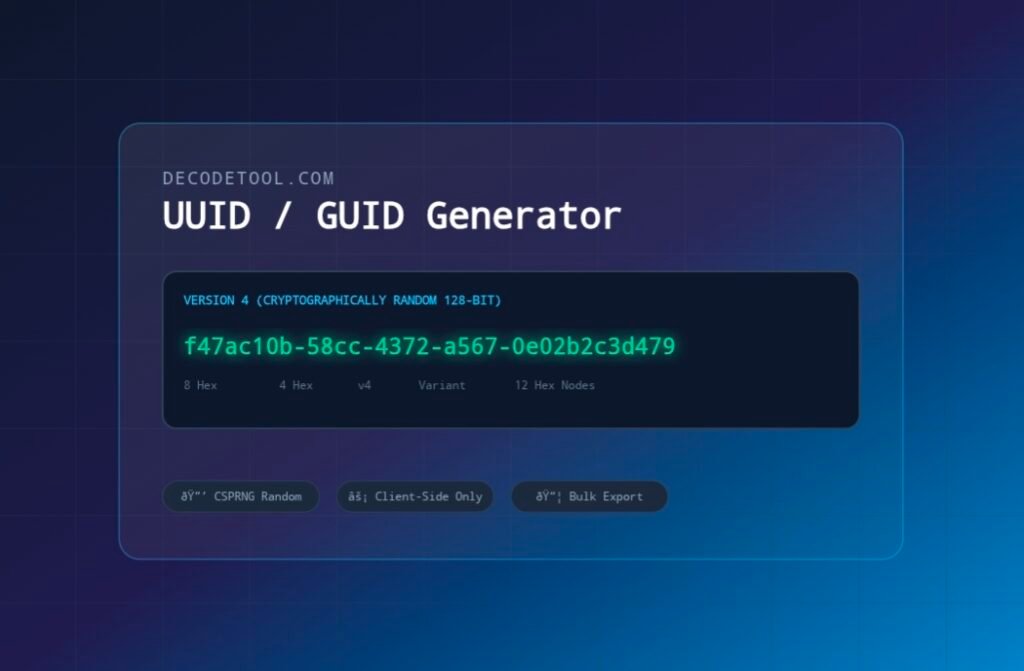
The solution to this architectural challenge is the UUID (Universally Unique Identifier)—also known as a GUID (Globally Unique Identifier) in the Microsoft ecosystem.
A UUID is a 128-bit identifier designed to guarantee uniqueness across space and time without requiring a central authority or coordinating server.
In this comprehensive guide, we will explore what UUIDs are, how the UUID Version 4 (v4) standard works, how cryptographic randomness guarantees collision prevention, and why unique 128-bit identifiers are critical for modern database design and distributed microservices.
What is a UUID?
A UUID (Universally Unique Identifier) is a 128-bit (16-byte) number standardized by the Internet Engineering Task Force (RFC 4122 and updated in RFC 9562).
Because a 128-bit raw binary string is difficult for humans to read and transfer, UUIDs are formatted as 32 hexadecimal characters separated by hyphens into five distinct groups:
$$\text{Format: } \mathbf{\text{8-4-4-4-12}}$$
Canonical Standard Representation Example:
$$\mathbf{\text{f47ac10b-58cc-4372-a567-0e02b2c3d479}}$$
Breakdown of the 36-character canonical string representation (32 hex digits + 4 hyphens):
$$\begin{array}{rcc} \text{Segment} & \text{Hexadecimal Width} & \text{Bit Count} \\ \hline \text{Group 1} & 8 \text{ characters} & 32 \text{ bits} \\ \text{Group 2} & 4 \text{ characters} & 16 \text{ bits} \\ \text{Group 3} & 4 \text{ characters} & 16 \text{ bits} \\ \text{Group 4} & 4 \text{ characters} & 16 \text{ bits} \\ \text{Group 5} & 12 \text{ characters} & 48 \text{ bits} \\ \hline \mathbf{\text{Total}} & \mathbf{32 \text{ hex digits}} & \mathbf{128 \text{ bits}} \end{array}$$
The Evolution of UUID Versions
The RFC specification defines several distinct algorithms for constructing UUIDs. Each version serves specific system architectural requirements:
                                  ┌───────────────────────────┐
                                  │      128-Bit Identifier   │
                                  └─────────────┬─────────────┘
                                                │
                 ┌──────────────────────────────┴──────────────────────────────┐
                 │                                                             │
                 ▼                                                             ▼
    ┌─────────────────────────┐                                   ┌─────────────────────────┐
    │  Deterministic UUIDs    │                                   │   Random / Time UUIDs   │
    ├─────────────────────────┤                                   ├─────────────────────────┤
    │ Version 1: MAC + Time   │                                   │ Version 4: Random Crypto│
    │ Version 3: MD5 Hash     │                                   │ Version 6: Reordered    │
    │ Version 5: SHA-1 Hash   │                                   │ Version 7: Unix Epoch   │
    └─────────────────────────┘                                   └─────────────────────────┘
| Version | Primary Source Material | Best Use Case | Key Characteristics |
| UUID v1 | Timestamp + Host MAC Address | Legacy tracking | Exposes hardware MAC address; leaks creation time. |
| UUID v3 | MD5 Hash + Namespace | Deterministic lookups | Obsolete due to MD5 cryptographic weaknesses. |
| UUID v4 | Cryptographically Random Bits | General Web APIs, Keys & Tokens | High entropy; fully unpredictable; widespread default. |
| UUID v5 | SHA-1 Hash + Namespace | Deterministic namespacing | Generates identical IDs for identical input strings. |
| UUID v7 | Unix Epoch Time + Random | Database Primary Keys (B-Trees) | Time-ordered; avoids index fragmentation while preserving randomness. |
Among all versions, UUID Version 4 remains the most widely deployed across web applications, front-end libraries, and REST API frameworks.
How UUID Version 4 Works
Unlike Version 1 (which relies on system clock ticks and hardware MAC addresses) or Version 5 (which hashes a URL or domain string), UUID Version 4 relies entirely on random numbers.
Out of the 128 total bits in a Version 4 UUID, 122 bits are purely random. The remaining 6 bits are reserved for version numbers and variant bits.
Bit Layout Breakdown of a UUID v4
Let us analyze a generated canonical UUID v4 string:
$$\text{f47ac10b-58cc-}\mathbf{4}\text{372-}\mathbf{a}\text{567-0e02b2c3d479}$$
- Version Indicator (Group 3):
- Look at the first character of the 3rd group (
4372). - The digit is fixed to
4. This explicitly flags the identifier as a Version 4 UUID.
- Look at the first character of the 3rd group (
- Variant Indicator (Group 4):
- Look at the first character of the 4th group (
a567). - In binary, the top two bits of this digit are set to
10. This indicates standard RFC 4122 Variant 1 formatting. - As a result, the first character of group 4 will always be one of four hexadecimal characters:
8,9,a, orb.
- Look at the first character of the 4th group (
- Random Payload (122 Bits):
- All other 122 bit positions are populated using random or pseudo-random byte sequences generated by system entropy pools.
Collision Probability: How Unique is “Unique”?
When developers first adopt random UUIDs, their primary concern is usually: “What if two users or servers generate the exact same UUID?”
Because a Version 4 UUID contains 122 bits of randomness, the total number of possible unique UUID v4 variations is:
$$2^{122} \approx 5.3 \times 10^{36}$$
To put $5.3 \times 10^{36}$ (5.3 undecillion) into physical perspective:
- If you generated 1 billion UUIDs every second for the next 100 years, the probability of creating a single collision is approximately $1 \text{ in } 1,000,000,000$ ($10^{-9}$).
- To reach a 50% chance of a collision (the Birthday Paradox threshold), you would need to generate approximately $2.3 \times 10^{18}$ (2.3 quintillion) UUIDs.
For practical software engineering purposes across databases, API session keys, and cloud infrastructure, UUID v4 collisions are mathematically negligible.
Why Cryptographic Randomness Matters
Not all random number generators are created equal.
In JavaScript, for example, the built-in Math.random() function uses a Pseudo-Random Number Generator (PRNG) algorithm (such as xorshift128+). While Math.random() is fast, it is cryptographically insecure:
- Its internal state can be reconstructed after observing a small sample of outputs.
- It can produce predictable sequences when executed in parallel web workers or cold-booted serverless containers (like AWS Lambda functions).
Predictable primary keys or session tokens expose applications to enumeration attacks, session hijacking, and security exploits.
The Cryptographic Standard: crypto.getRandomValues()
To securely generate UUID v4 identifiers client-side or server-side, applications must use a Cryptographically Secure Pseudo-Random Number Generator (CSPRNG):
- In the Browser:
crypto.randomUUID()orcrypto.getRandomValues(new Uint8Array(16)) - In Node.js:
crypto.randomUUID()orrequire('crypto').randomBytes(16)
These APIs pull entropy directly from the underlying operating system kernel (e.g., /dev/urandom in Linux or BCryptGenRandom in Windows), making generated keys mathematically unpredictable.
Our free UUID / GUID Generator on decodetool.com uses browser-native CSPRNG entropy pools to generate keys locally on your device.
UUIDs vs. Auto-Incrementing Integers: Architectural Comparison
Choosing between traditional auto-incrementing integer IDs (1, 2, 3...) and 128-bit UUIDs significantly impacts your database architecture, application security, and system scalability.
Auto-Incrementing Integer Architecture (Centralized Bottleneck):
Client A ──────┐
Client B ──────┼───► [ Central Database Auto-Increment Lock ] ───► ID: 101, 102
Client C ──────┘

UUID Architecture (Decentralized & Parallel):
Client A (Generates UUID Local) ───┐
Client B (Generates UUID Local) ───┼───► [ Distributed DB Cluster ] ───► Writes Directly
Client C (Generates UUID Local) ───┘
| Feature / Metric | Auto-Incrementing Integer (INT / BIGINT) | UUID Version 4 (UUID / BINARY(16)) |
| Storage Size | 4 Bytes (INT) or 8 Bytes (BIGINT) | 16 Bytes (Raw Binary) or 36 Bytes (String) |
| Generation Location | Central Database Server only | Any Client, Web Browser, or API Service |
| Security / Privacy | Low (Predictable; vulnerable to enumeration) | High (Unpredictable 128-bit random payload) |
| Distributed Scaling | Difficult (Requires master DB write lock) | Seamless (Zero coordination required) |
| Database Indexing | Excellent (Sequential B-Tree insert) | Requires optimization (Random inserts fragment B-Trees) |
1. Eliminating Security Vulnerabilities (Sequential Enumeration)
When web applications expose auto-incrementing primary keys in public URL endpoints:
$$\text{[https://example.com/api/v1/orders/1042](https://example.com/api/v1/orders/1042)}$$
An attacker can execute a simple script to increment the numerical ID (1043, 1044, 1045), exposing total customer volume, proprietary business metrics, or unauthorized records.
By replacing sequential IDs with UUIDs:
$$\text{[https://example.com/api/v1/orders/f47ac10b-58cc-4372-a567-0e02b2c3d479](https://example.com/api/v1/orders/f47ac10b-58cc-4372-a567-0e02b2c3d479)}$$
The URL path is unpredictable, preventing enumeration exploits.
2. Enabling Client-Side Primary Key Generation
In offline-first applications (such as mobile apps or rich text editors), users create records locally without an active internet connection.
With auto-incrementing keys, the application must wait for a server response before assigning an ID. With UUIDs, the client generates a cryptographically valid primary key instantly, saves the record to local storage (IndexedDB / SQLite), and syncs with the central database when reconnected—guaranteeing zero primary key collisions.
Best Practices for Storing UUIDs in Databases
While UUIDs offer massive architectural advantages, storing them as raw 36-character ASCII strings (VARCHAR(36)) in relational databases like MySQL, PostgreSQL, or SQL Server can hurt disk storage and query performance.
1. Store as Native UUID or BINARY(16) Types
- PostgreSQL: Uses a native
UUIDdata type that automatically compresses the 36-character string into 16 raw binary bytes. - MySQL / MariaDB: Store as
BINARY(16). Use MySQL’s built-in functionsUUID_TO_BIN()andBIN_TO_UUID()to convert between human-readable hex and compressed binary storage.
SQL
-- MySQL Example: Storing UUID v4 as compressed 16-byte binary
CREATE TABLE users (
    id BINARY(16) PRIMARY KEY,
    email VARCHAR(255) NOT NULL
);

-- Inserting a UUID
INSERT INTO users (id, email)
VALUES (UUID_TO_BIN('f47ac10b-58cc-4372-a567-0e02b2c3d479'), 'user@example.com');

-- Querying the UUID
SELECT BIN_TO_UUID(id) AS id, email FROM users;
2. Addressing B-Tree Index Fragmentation (UUID v4 vs UUID v7)
Because UUID v4 is completely random, inserting new records into indexed relational database tables forces random updates across B-Tree index pages. On large tables (tens of millions of rows), this causes page splitting and cache misses.
For high-throughput database workloads where index sequential insertion is vital, consider using UUID Version 7 for database primary keys (which prefixes a time-ordered Unix timestamp), while retaining UUID Version 4 for API tokens, session cookies, and public object references.
Step-by-Step: Generating UUIDs Online using decodetool.com
Generating secure UUIDs for testing, database seeding, API design, or mock configuration files is simple with the UUID / GUID Generator on decodetool.com.
 ┌─────────────────────────────────────────────────────────────┐
 │                Configure Generation Settings                │
 └──────────────────────────────┬──────────────────────────────┘
                                │
                                ▼
 ┌─────────────────────────────────────────────────────────────┐
 │    Local Browser CSPRNG (crypto.getRandomValues)            │
 └──────────────────────────────┬──────────────────────────────┘
                                │
                                ▼
 ┌─────────────────────────────────────────────────────────────┐
 │ Formatted Output: uppercase, lowercase, hyphens, or braces  │
 └─────────────────────────────────────────────────────────────┘
Features of the Tool:
- Bulk Generation: Generate anywhere from 1 to 100 UUIDs instantly in a single click.
- Flexible Formatting Options:
- Toggle between lowercase (
f47ac10b...) and UPPERCASE (F47AC10B...). - Toggle 8-4-4-4-12 hyphens on or off.
- Add surrounding braces
{ ... }for Windows C# / .NET GUID compatibility. - Add quotes
"..."for quick insertion into JSON arrays or code declarations.
- Toggle between lowercase (
- 100% Client-Side Privacy: Your generated UUIDs are constructed in memory using your browser’s native JavaScript crypto API. No data is logged, transmitted, or stored on external servers.
Frequently Asked Questions (FAQ)
What is the difference between a UUID and a GUID?
There is no functional difference. UUID (Universally Unique Identifier) is the open IETF standard term (RFC 4122), while GUID (Globally Unique Identifier) is Microsoft’s implementation term. Both refer to the same 128-bit unique identifier structure.
Can two identical UUID v4s ever be generated?
Mathematically, it is possible, but the probability is so infinitesimally small ($1 \text{ in } 2^{122}$) that it is treated as zero in modern software engineering.
Is UUID v4 safe for sensitive security tokens?
Yes, provided it is generated using a cryptographically secure random source (crypto.getRandomValues() or crypto.randomUUID()). However, for high-security password reset tokens or secret API keys, cryptographic tokens with 256 bits of entropy (like SHA-256 tokens) are recommended.
How many characters are in a standard UUID string?
A standard canonical UUID contains 36 characters: 32 hexadecimal digits and 4 hyphens. Without hyphens, it contains 32 hexadecimal characters.
Generate Secure UUIDs Online Today
Need unique identifiers for your database primary keys, session state handling, or API development? Try our fast, secure, browser-based UUID / GUID Generator on decodetool.com today!